01
Encrypted package
Your memory never leaves your device unencrypted. Only you hold the key.
Product
The memory for AI. Your knowledge, decisions and experience accumulate in a single memory; ask, and it remembers with the reasoning. MCP-capable AI tools connect to the same memory — even when the model changes, the memory stays with you. You decide where it lives.

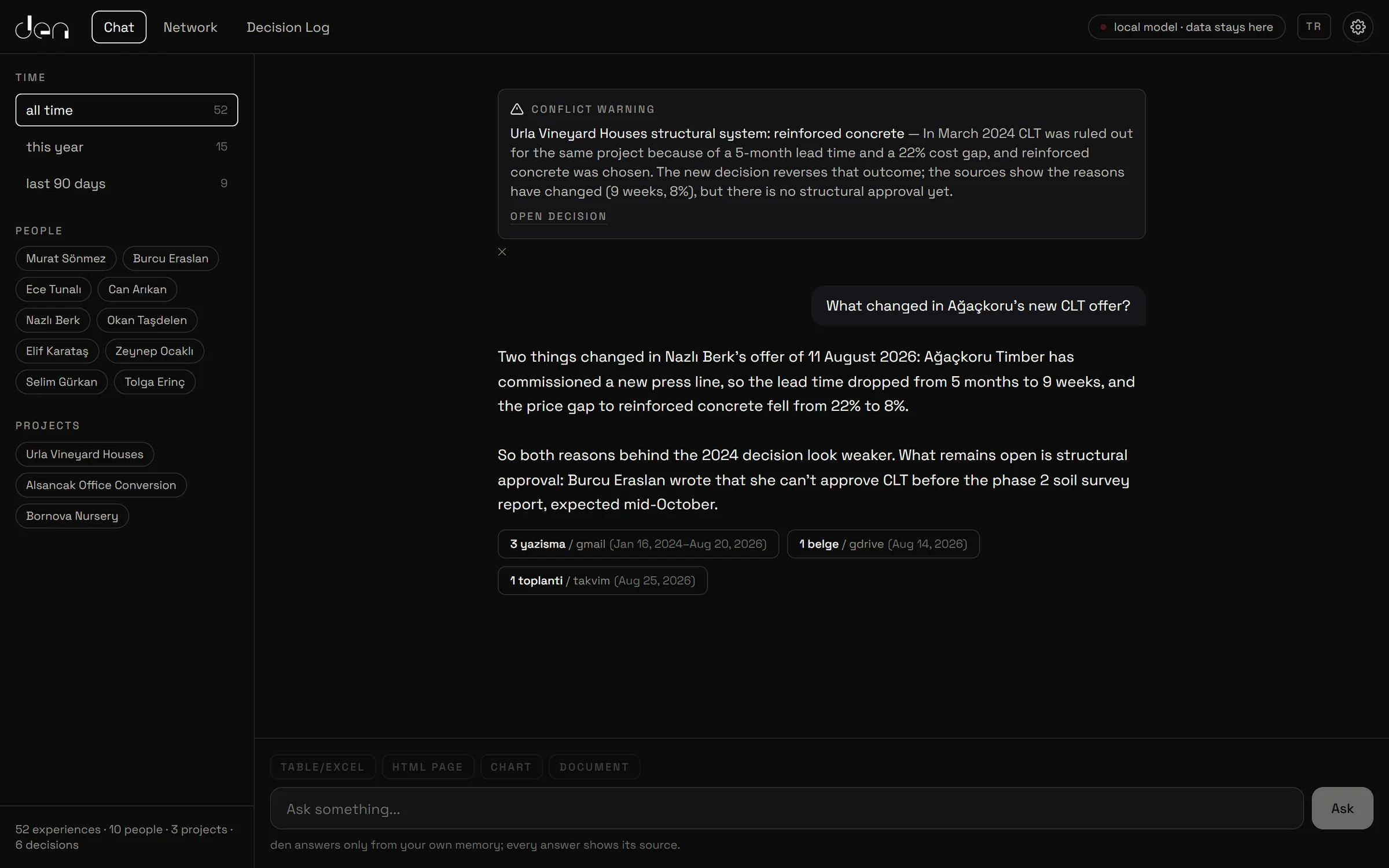
Chat
Under every answer, source cards show which email, which document and which decision the information came from.
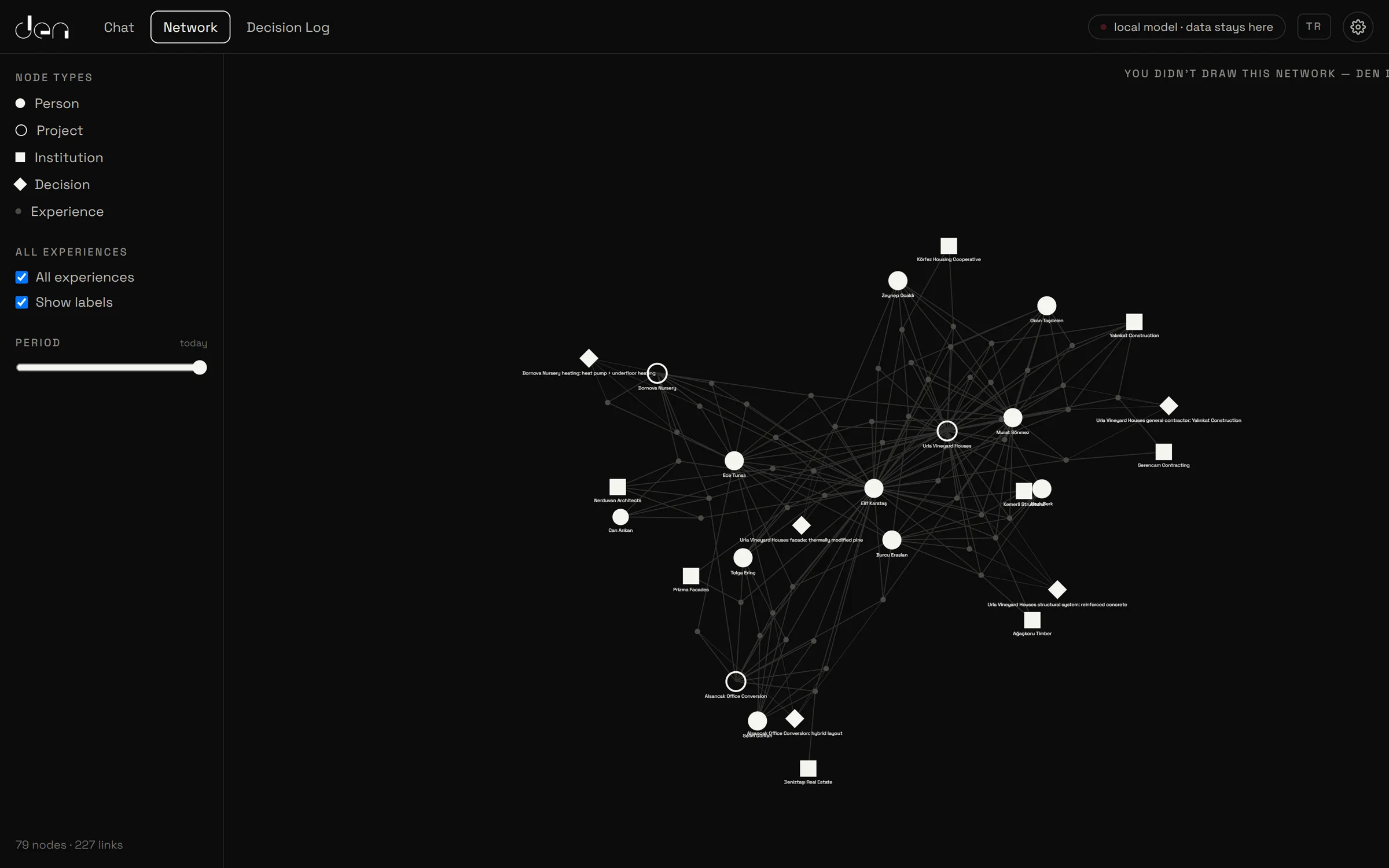
Graph
The links between people, organizations, projects and decisions are extracted from your archive automatically.
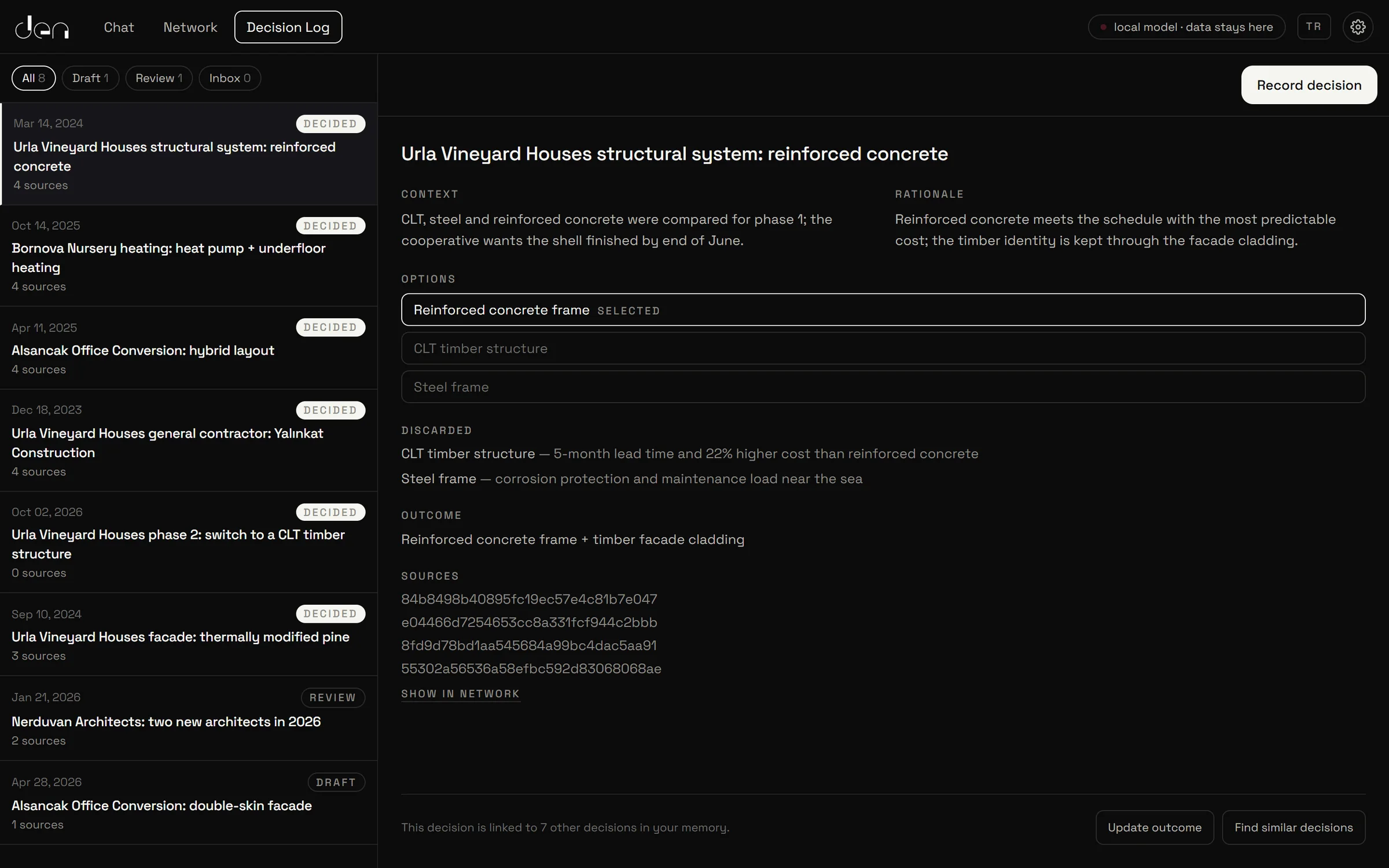
Decision Log
Context, options, what was ruled out and the outcome in one place; it warns you when a new decision contradicts the past.
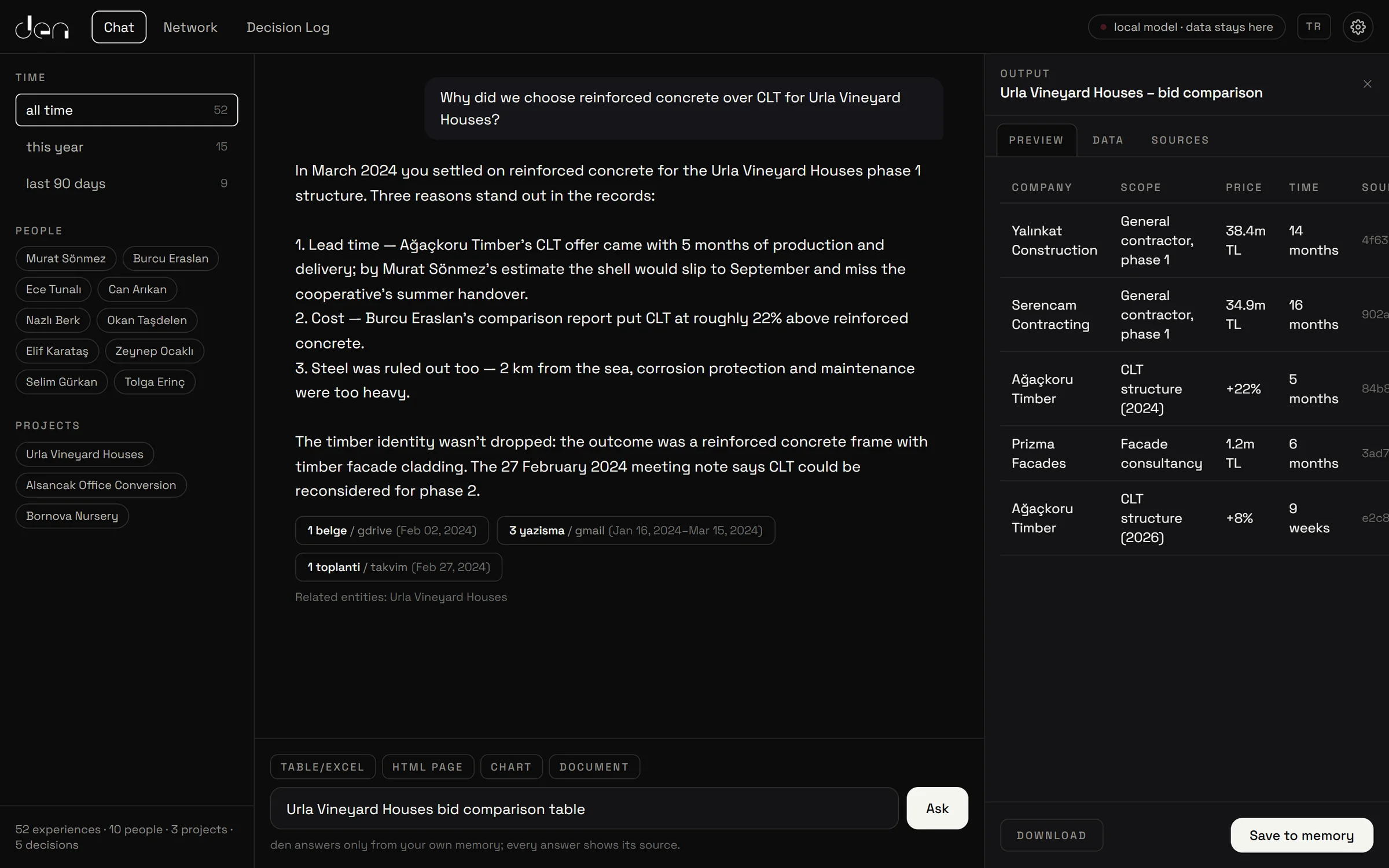
Output Panel
It produces the output you ask for, grounded in your memory; download it or save it back into memory.
Two Memories
01
With an On-Site installation, contracts, emails, documents, projects... Your organization's experience becomes a connected memory network. 'What happened with this supplier before?' no longer depends on anyone's recollection.
02
Your decisions, your reasoning, the paths you didn't take. den learns your decision history; ask 'what did I think about this last year?' and it answers with date, context and rationale. It even tells you when you contradict yourself.
den Second Brain · On-Site
It runs on your own infrastructure. It can run fully air-gapped on open-source models; agent access is written to a tamper-evident audit trail. Role-based access is on the roadmap.
den Second Brain · Portable
Your second brain goes into an end-to-end encrypted package, is stored in the cloud and restored on any device you choose. Its integrity is on record — no one but you can open the package, not even den.
01
Your memory never leaves your device unencrypted. Only you hold the key.
02
Use your recovery phrase to restore your memory, exactly as it was, on another computer.
03
Your package's integrity and version history are on record; you can verify at any time that your memory hasn't changed.
| On-Site | Portable | |
|---|---|---|
| Who it's for | Organizations and decision-makers | Individuals |
| Where the memory lives | On your own infrastructure | In an encrypted package, in the cloud |
| Access | Internal (role-based access on the roadmap) | Only you (you hold the key) |
| Setup | Installation and handover | One click from the app |
| Pricing | By quote | Monthly subscription (coming soon) |
Both are the same product; moving your memory between editions is coming soon.